The Number Every SaaS Vendor Should Be Watching
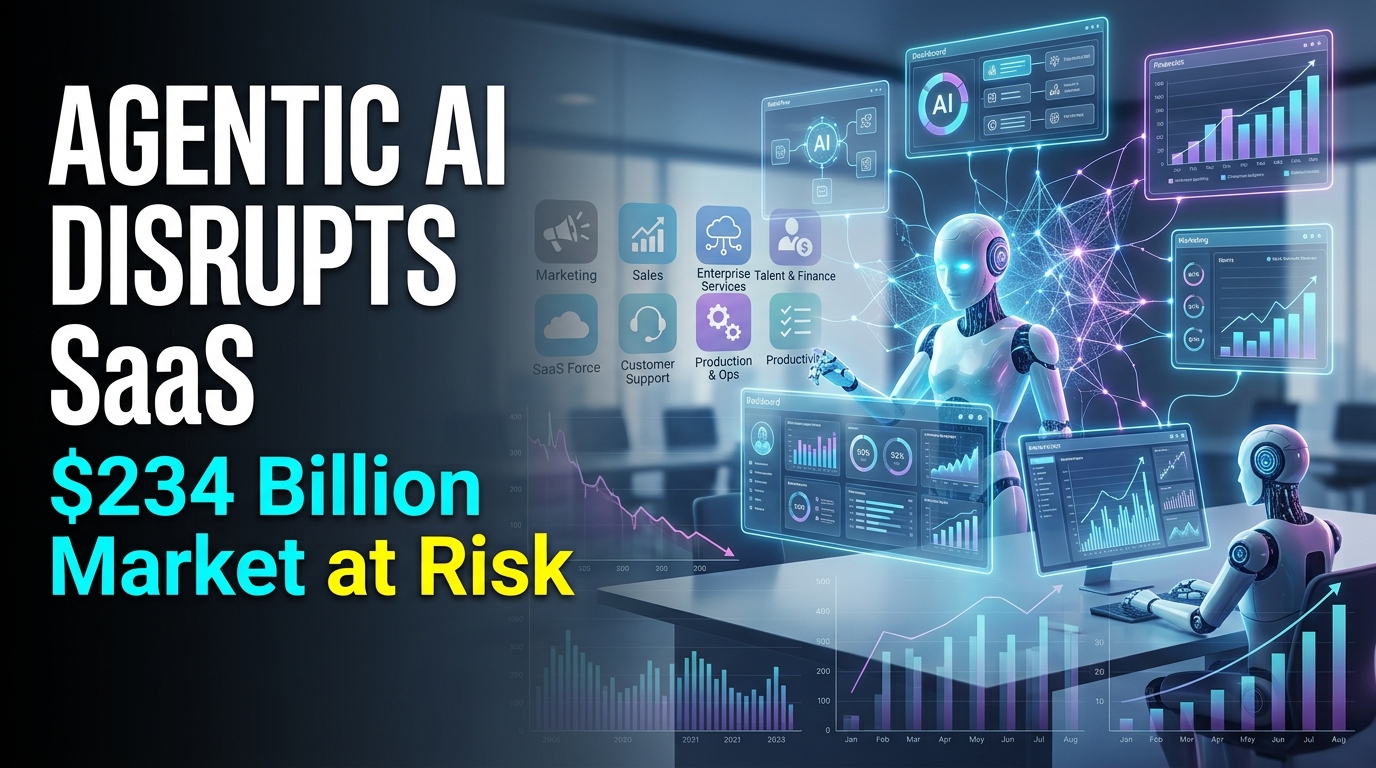
Enterprise software has spent two decades built around a simple assumption: humans log in, click through interfaces, and pay per seat for the privilege. Gartner's newest research, published July 8, 2026, puts a hard number on how fast that assumption is breaking down — $234 billion in enterprise SaaS spending is now at risk as AI agents increasingly complete business tasks without ever touching a traditional software screen.
What Gartner Actually Means by “At Risk”
The mechanism Gartner points to is what it calls "agentic arbitrage" — AI agents completing work across multiple enterprise systems by calling APIs directly, cutting out the need for a human to interact with each individual application's interface. That breaks a link that's been foundational to SaaS economics for years: the connection between user growth and revenue growth. If an agent can complete a workflow that previously required five people logging into five different tools, the vendor's per-seat pricing model loses its underlying logic even if the software itself is still doing useful work.
Why This Changes How CIOs Should Evaluate Software
Gartner's Distinguished VP Analyst framed the shift in blunt terms: agentic AI changes the economics of software because these systems often bypass traditional applications entirely and deliver outcomes directly. The practical implication for enterprise buyers is a fundamentally different evaluation question. Instead of asking how good a tool's interface and user experience are, CIOs are being advised to assess whether AI agents can perform every function a human user currently performs through the application's screens — accessed instead through APIs.
How SaaS Pricing Is Already Responding
| 💳 Pricing Model | 📈 2026 Status |
|---|---|
| 👤 Pure Per-Seat Licensing | Facing direct pressure as AI agents increasingly act as de facto users within software platforms. |
| 🔄 Hybrid Model (Platform Fee + Usage) |
Becoming the default pricing approach across many SaaS products. |
| ⚡ Usage-Based Pricing (Tokens, API Calls, Actions) |
Growing rapidly, with providers adding usage caps and credits to reduce unexpected billing spikes. |
| 🎯 Outcome-Based Pricing | Increasing adoption in enterprise contracts, although complete "day zero" transformation has not yet become mainstream. |
Vendors are increasingly bundling AI features into higher-tier plans or billing by credits, tokens, and discrete actions rather than treating AI as a flat add-on. That shift raises average contract value in the near term, but it also removes the lower-cost "AI-free" tier that many budget-conscious buyers previously relied on — a tradeoff that's starting to show up directly in renewal and expansion conversations.
Industry Impact
The shift is forcing a reclassification across the SaaS landscape into two rough camps: AI-enabled platforms, which are traditional tools with AI features layered on top, and AI-native platforms, built from the ground up around autonomous agents performing work rather than assisting a human doing it. Since most vendors now offer some form of AI capability, buyers are being advised to evaluate depth of integration and measurable business impact rather than treating "has AI" as a meaningful differentiator on its own — a distinction that's also shaping where venture capital flows, with July 2026's biggest funding rounds concentrating heavily around AI infrastructure rather than consumer-facing AI features.
Expert Analysis
IT's role is expanding in parallel with this shift — from operator of individual tools to orchestrator of a broader portfolio of tools, data, and autonomous agents, a change that itself requires new governance and cost-optimization skills that most IT organizations are still building. FinOps discipline specific to SaaS is increasingly treated as essential rather than optional: without tracking usage and token consumption closely, organizations risk AI features costing more than the value they deliver, particularly as usage-based components make monthly spend far less predictable than flat per-seat billing ever was.
What This Means for SaaS Vendors Specifically
- Per-seat-only pricing is increasingly a liability, not a safe default, as agentic buyers evaluate tools by API-accessible capability rather than seat count.
- Transparent pricing pages are becoming a competitive advantage, with buyers wanting public ranges, usage examples, and overage rules before ever talking to sales.
- API completeness now matters as much as UI quality — a tool an agent can't fully operate through its API risks exclusion from agentic workflows entirely, regardless of how polished its human-facing interface is.
- Governance and cost-visibility tooling are emerging as their own product category, layered on top of the AI features driving the disruption in the first place.
Timeline
- 2019-2022: Usage-based pricing rises from roughly 30% to 61% of SaaS companies using some form of it.
- 2025: Gartner projects over 30% of enterprise SaaS solutions will incorporate outcome-based pricing components, up from ~15% in 2022.
- Early 2026: Hybrid pricing (platform fee plus metered usage) becomes the default structure across most new SaaS contracts.
- July 8, 2026: Gartner publishes its $234 billion at-risk enterprise SaaS spending analysis tied to agentic AI adoption.
Future Outlook
Expect the vendors best positioned through this transition to be the ones that treat API-first architecture and usage transparency as core product priorities now, rather than retrofitting them once agentic buying patterns become the norm rather than the exception. For enterprise buyers, the practical takeaway is to start evaluating incumbent tools against a simple question: could an AI agent complete this workflow through the vendor's API today, and if not, how exposed is that vendor to being bypassed entirely over the next contract cycle.
Frequently Asked Questions
What does Gartner mean by “agentic arbitrage”?
AI agents completing business tasks across multiple enterprise systems via APIs, reducing or eliminating the need for employees to interact with individual software interfaces directly.
How much enterprise SaaS spending is at risk?
Gartner estimates $234 billion in enterprise SaaS spending is at risk due to agentic AI adoption, as of its July 8, 2026 analysis.
Why does agentic AI threaten per-seat pricing specifically?
Per-seat pricing depends on a direct link between user count and revenue; when an AI agent completes work that previously required multiple human users, that link breaks down.
What’s the difference between AI-enabled and AI-native SaaS?
AI-enabled platforms are traditional tools with AI features added on; AI-native platforms are built from the ground up around autonomous agents performing work directly.
How should CIOs evaluate software differently now?
Gartner recommends assessing whether AI agents can perform the same functions through APIs that human users currently perform through application interfaces, rather than focusing primarily on UI and user experience.
What pricing models are replacing traditional per-seat licensing?
Hybrid pricing — combining a platform or seat fee with metered usage for AI, API calls, or workflows — is becoming the default, alongside growing adoption of outcome-based components.
What should SaaS vendors do to prepare?
Prioritize complete, agent-accessible APIs, adopt transparent usage-based pricing with clear caps, and build governance tooling that helps enterprise buyers track and control AI-driven costs.
Key Takeaways
- Gartner estimates $234 billion in enterprise SaaS spending is at risk as agentic AI bypasses traditional software interfaces.
- "Agentic arbitrage" breaks the traditional link between user growth and SaaS revenue growth.
- Hybrid and usage-based pricing are becoming the default as pure per-seat licensing comes under pressure.
- CIOs are being advised to evaluate software by API-accessible agent capability, not just user interface quality.
References
- Gartner (via CIO.com)
- BetterCloud 2026 State of SaaS Report
- Deloitte 2026 TMT Predictions