Flying Costs a Lot More Than It Did Last Summer — Here’s Why
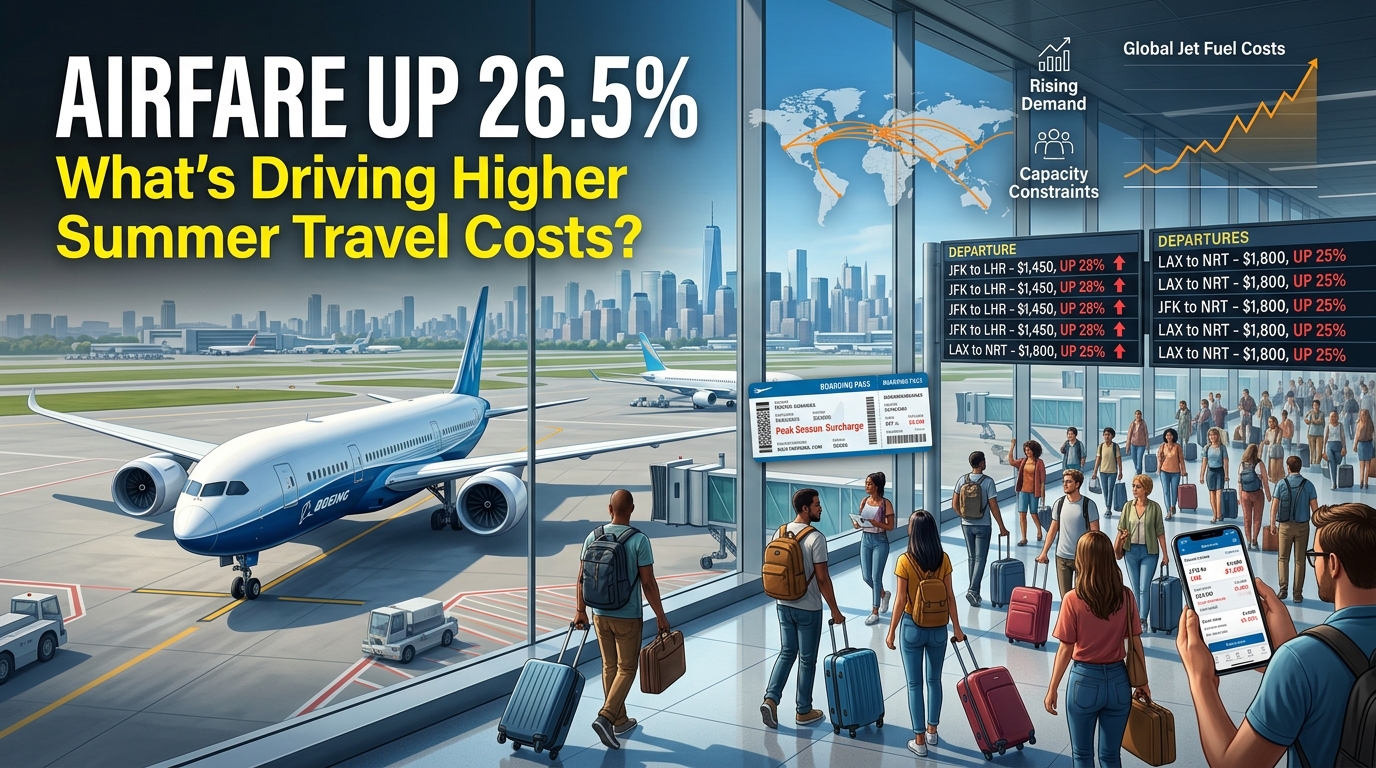
If your flight this summer feels more expensive than it did last year, the data backs that up emphatically. According to NerdWallet's July 2026 Travel Inflation Report, drawing on the latest Bureau of Labor Statistics Consumer Price Index data, airfare costs are up 26.5% over the past year — dramatically outpacing broader inflation, which rose 3.4% over the same period, and far ahead of increases in dining out (3.4%) or entertainment (3.6%).
The Numbers Behind the Squeeze
| 📊 Category | 📈 Year-Over-Year Change |
|---|---|
| ✈️ Airfare | +26.5% increase year-over-year. |
| 🏨 Lodging | +4.8% increase compared with the previous year. |
| 📈 Overall Inflation (All Items) |
+3.4% annual increase across all categories. |
| 🍽️ Eating Out | +3.4% increase in restaurant and dining costs. |
| 🎭 Entertainment | +3.6% year-over-year growth. |
Airfare's outsized increase stands out sharply against every other travel-adjacent cost category, making flights by far the biggest line item pushing up total trip costs this summer — a genuinely different pattern from prior years, when lodging and dining increases tended to move more in line with each other.
Why Airfare Specifically Is Climbing So Fast
Part of the answer is reduced competition. Whenever airlines merge, exit the market, or pull out of specific routes, the remaining carriers gain more pricing power on those routes with less competitive pressure to keep fares down — a dynamic that's compounded when it happens across multiple markets simultaneously. Rising fuel costs have also been cited as a contributing factor across the industry more broadly, adding structural cost pressure on top of the competitive dynamics shaping individual routes.
How Travelers Are Actually Responding
Rather than skipping trips entirely, travelers appear to be adjusting how they travel. Deloitte's 2026 Summer Travel Survey found the average length of stay has declined 1.7% year-over-year to 5.9 days, reflecting a shift toward shorter, more tightly planned trips designed to control total spend without eliminating travel altogether. Just 45% of Americans plan a summer vacation involving paid accommodations this year — the lowest figure in six years — while 32% of non-travelers cite cost as their primary reason for skipping travel entirely, and 35% say they simply can't afford it.
July Remains the Peak — But the Season Is Stretching
Despite the cost pressure, summer travel demand hasn't collapsed. Deloitte's survey found 31% of all planned summer travel for 2026 will happen in July specifically, making it the single busiest month of the season. Interestingly, the season itself is stretching later: trips taking place after Labor Day have grown from 12% of summer travel in 2022 to 20% in 2026, suggesting travelers are spreading trips across a longer window — likely partly as a strategy to find lower fares outside the most compressed peak-demand weeks.
A Notable Exception: World Cup Host Cities
One segment bucking the broader shorter-trip trend is travel tied to the 2026 FIFA World Cup, co-hosted by the United States, Canada and Mexico. Expedia data shows search interest in host cities has spiked dramatically, with Kansas City up 700%, Philadelphia and Monterrey both up 210%, and Atlanta up 200% year-over-year. That demand hasn't fully converted into bookings yet, however — early industry data shows inbound travel to U.S. host cities has been slower than the search spike would suggest, with hotels raising rates roughly 55% year-over-year while occupancy for World Cup dates remains in the single digits, as fans wait on ticket allocations and match schedules before committing to bookings.
Industry Impact
The combination of steep airfare inflation and cautious, shorter-trip booking behavior is forcing airlines and travel companies to rethink pricing and marketing strategy mid-season. Industry analysts note the pattern reflects genuine price sensitivity rather than declining interest in travel itself — demand keeps reactivating as departure dates approach even after periods of booking hesitation, suggesting travelers are strategically timing purchases rather than abandoning trip plans altogether.
What Travelers Can Actually Do About It
- Book early but stay flexible on exact dates, since limited availability on popular routes is compounding the pricing pressure this year.
- Consider shoulder-season travel given the documented shift toward post-Labor Day trips, which may offer more availability and softer pricing than peak July dates.
- Watch for airline competition changes on your specific route — mergers or route exits by competing carriers are a documented driver of higher fares.
- For World Cup host city travel specifically, monitor ticket allocation announcements before booking non-refundable accommodations, given the current gap between search interest and confirmed demand.
Timeline
- Early 2026: Flight booking demand grows strongly in January before softening through March and April amid inflation and fuel cost concerns.
- Late May 2026: Booking activity rebounds sharply as summer travel dates approach.
- July 2-6, 2026: Domestic flight bookings for the July 4 holiday period rise 8.1% year-over-year.
- July 2026: NerdWallet's Travel Inflation Report, based on June 2026 BLS data, confirms 26.5% year-over-year airfare growth.
- June-July 2026: World Cup host city search interest spikes sharply ahead of the tournament.
Future Outlook
Expect airfare to remain the primary driver of overall trip cost increases through the rest of 2026, with the shorter-trip, more-flexible-timing pattern likely to persist as travelers continue balancing budget constraints against a genuine desire to keep traveling. The World Cup host city gap between search interest and actual bookings will be worth watching closely in the coming weeks, as ticket allocations firm up and travelers decide whether to commit to trips at currently elevated hotel rates.
Frequently Asked Questions
How much has airfare increased in 2026?
Airfare costs are up 26.5% year-over-year as of NerdWallet's July 2026 report, based on June 2026 BLS Consumer Price Index data.
Why is airfare rising so much faster than other travel costs?
Reduced airline competition from mergers and route exits, combined with rising fuel costs, are cited as key drivers of the outsized airfare increase.
Are people traveling less because of higher prices?
Not entirely — travelers are adjusting by taking shorter trips (average length of stay down 1.7% to 5.9 days) rather than skipping travel altogether, though some are opting out due to cost.
What month sees the most summer travel in 2026?
July, with 31% of all planned summer travel happening that month according to Deloitte's 2026 Summer Travel Survey.
Is summer travel season getting longer?
Yes — trips after Labor Day have grown from 12% of summer travel in 2022 to 20% in 2026.
Why is World Cup host city hotel occupancy low despite high search interest?
Fans appear to be waiting on ticket allocations and match schedules before committing to non-refundable travel bookings, even as search interest has spiked.
How much have lodging prices increased?
Lodging prices are up 4.8% year-over-year, a much smaller increase than airfare's 26.5% rise.
Key Takeaways
- Airfare is up 26.5% year-over-year in 2026, far outpacing overall inflation and other travel cost categories.
- Travelers are responding with shorter trips (5.9 days average) rather than abandoning travel plans entirely.
- July remains the busiest travel month, but the summer season is stretching later into September.
- World Cup host cities are seeing huge search interest spikes that haven't yet translated into confirmed bookings, amid elevated hotel rates.
References
- NerdWallet
- Deloitte 2026 Summer Travel Survey
- TravelAge West
- Travel And Tour World
- Expedia (via Mind Body Globe)