
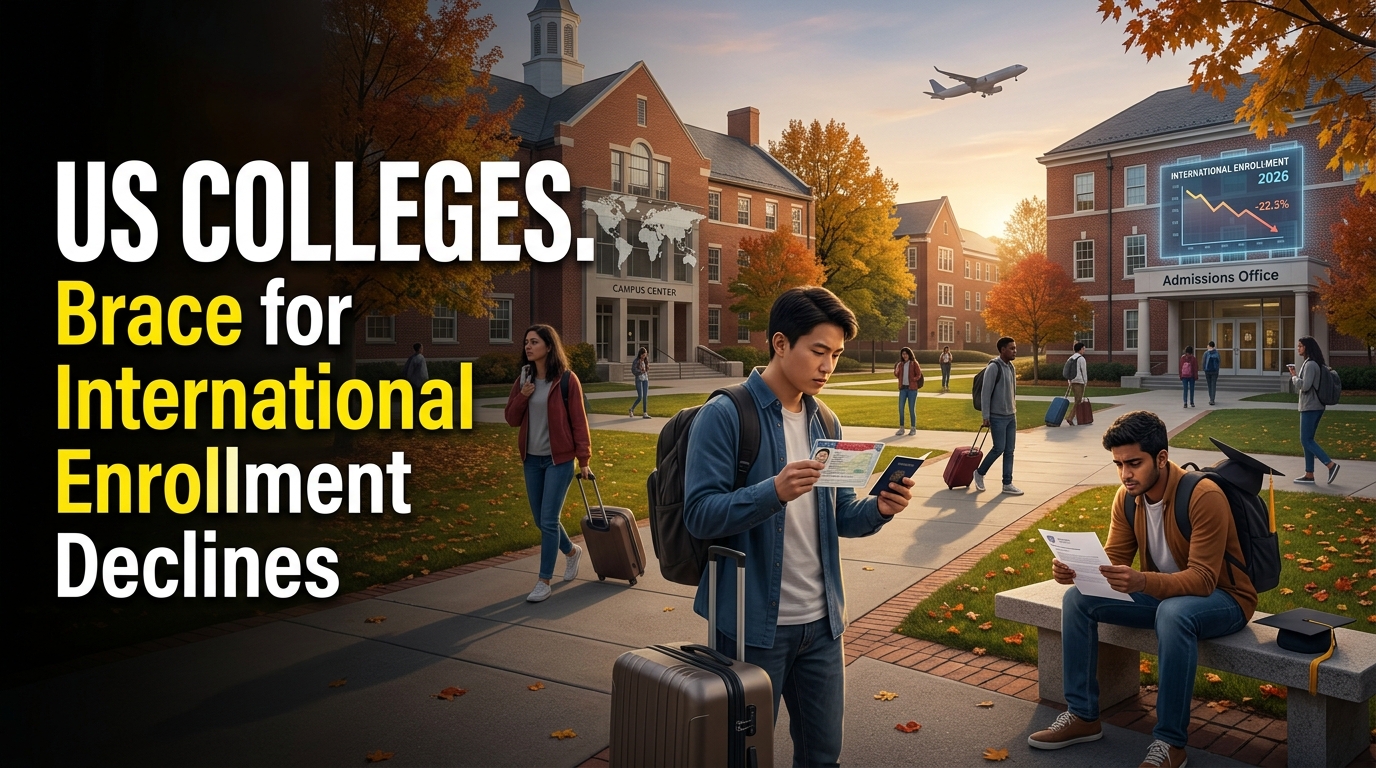
A Sharp, Widely-Felt Drop Across American Higher Education
New survey data is putting hard numbers on a trend university administrators have been bracing for all year. According to the Institute of International Education's (IIE) Spring 2026 Snapshot, released in early July, 59% of surveyed U.S. colleges and universities have already seen international applications decline for the 2026-27 academic year, and 63% expect overall international enrollment to fall once the fall semester begins.
The Numbers at a Glance
| 📊 Metric | 📈 Figure |
|---|---|
| 🏫 Institutions Surveyed | 585 institutions, representing 48% of all international students in the U.S. |
| 📉 Decline in Applications | 59% of institutions reported lower application numbers. |
| 🎓 Graduate Applications Decline | 65% reported declines specifically in graduate applications. |
| 📚 Undergraduate Applications Decline | 60% reported fewer undergraduate applications. |
| 📅 Expected Enrollment Decline (2026–27) | 63% expect overall international enrollment to decrease. |
| ⚠️ Expected "Substantial Decline" | Approximately 24% of institutions expect a substantial drop — nearly 1 in 4. |
| 📈 Expected Enrollment Growth | 11% expect international enrollment to increase. |
| 📉 Previous Year Enrollment Change (2025–26) | New international enrollment declined by 17%. |
This year's projected decline builds directly on an already difficult prior year — new international enrollment fell 17% in 2025-26, and separate National Student Clearinghouse Research Center data found international graduate enrollment specifically sank 4.3% in spring 2026 alone, with public four-year colleges hit hardest at a 9.2% year-over-year loss.
What Institutions Say Is Driving the Decline
Among institutions expecting enrollment to fall, the survey identified several overlapping factors cited as contributing causes: 92% pointed to visa application barriers, 80% cited U.S. travel restrictions, and 77% said prospective students appear to be choosing universities in other countries instead. On the policy side, two specific federal changes were widely referenced by respondents: a Department of State announcement in January 2026 that it had revoked more than 100,000 visas overall, including roughly 8,000 student visas, and a May 2026 Department of Homeland Security rule ending the long-standing "Duration of Status" policy for international students, replacing it with fixed admission periods of typically four years.
Where the Impact Is Concentrated
The decline isn't evenly distributed. Reporting has specifically pointed to a sharp drop in interest from Indian students as a major driver of the overall numbers — notable given India has been the largest single source of international students to the US in recent years, accounting for nearly half of all international graduate students. Public research universities with graduate programs heavily dependent on international enrollment, and the local businesses and labs that depend on that population, are among those most directly exposed to the financial fallout.
What’s at Financial Stake
International students contribute an estimated $43 billion annually to the U.S. economy. A sustained enrollment decline at the scale currently being reported would translate into an estimated $7 billion revenue loss and roughly 60,000 fewer jobs nationwide, concentrated particularly around public universities, graduate research programs, and campus-adjacent local economies. Individual institutions are already citing specific dollar impacts: one public university's draft budget projected a 40% decline in international graduate students would contribute to a $13-15.6 million tuition revenue shortfall for the 2026 fiscal year.
How Institutions Are Responding
Despite the headwinds, the survey found colleges aren't retreating from international recruitment altogether — 84% of institutions still consider it a priority, though that's down modestly from 89% in the prior year's survey, and nearly as many are holding or increasing recruitment budgets rather than cutting them. Common responses documented in the survey and follow-up interviews include:
- Offering enrollment deferrals — 72% of institutions offered deferrals to spring 2026, and 56% offered them for fall 2026, to accommodate students facing visa delays.
- Diversifying recruitment geography — advisors are specifically urging universities to diversify recruitment within India rather than moving away from the country entirely, alongside broader geographic diversification.
- Emphasizing outcomes over brand — shifting recruitment messaging toward concrete career and earnings outcomes rather than institutional prestige alone.
- Prioritizing transparent, consistent communication with prospective students to reduce uncertainty during a period of shifting federal policy.
Why Students Are Looking Elsewhere
The competitive landscape has genuinely shifted alongside the policy environment. Countries including Germany and Japan have continued actively expanding efforts to recruit international students, often marketing degree programs that cost meaningfully less than comparable American institutions — giving prospective students facing US visa uncertainty and rising costs a more concrete alternative than simply staying home.
Industry Impact
Beyond individual university budgets, the decline has broader implications for US research capacity and STEM talent pipelines, given how heavily American graduate programs in technical fields have historically relied on international students both to teach undergraduate courses and staff research labs. Universities that depend on international tuition revenue to cross-subsidize other institutional priorities are facing difficult near-term budget planning as they wait to see how the fall 2026 numbers ultimately land.
Timeline
- 2024-25: International graduate enrollment dips 2.7% following four years of steady growth.
- 2025-26: New international student enrollment falls 17% overall.
- January 12, 2026: The State Department announces it has revoked more than 100,000 visas, including approximately 8,000 student visas.
- May 5, 2026: DHS finalizes a rule ending "Duration of Status" for international students, replacing it with fixed admission periods.
- Spring 2026: International graduate enrollment falls an additional 4.3% year-over-year.
- Early July 2026: IIE publishes its Spring 2026 Snapshot survey findings, showing 63% of institutions expect further declines for 2026-27.
Future Outlook
The real test of these projections arrives with fall 2026 enrollment numbers, which will show whether the survey's 63% decline expectation matches actual student behavior once final visa processing and travel decisions play out. Given that 84% of institutions still prioritize international recruitment despite the headwinds, expect continued investment in deferral flexibility, geographic diversification, and outcomes-focused marketing as the primary tools schools use to offset policy-driven declines, rather than a wholesale retreat from international student recruitment.
Frequently Asked Questions
How many US colleges expect international enrollment to decline in 2026-27?
63% of institutions surveyed by IIE expect a decline, with nearly 1 in 4 anticipating a "substantial" decline.
What are colleges citing as the main causes?
Among institutions expecting declines, 92% cited visa application barriers, 80% cited US travel restrictions, and 77% said students are choosing universities in other countries.
Which international students are most affected?
Reporting has specifically pointed to a sharp decline in interest from Indian students as a major driver of the overall numbers.
How much money does international student enrollment contribute to the US economy?
An estimated $43 billion annually; a sustained decline at the current reported scale could translate to a $7 billion revenue loss and roughly 60,000 fewer jobs.
What policy changes have affected international student visas?
A January 2026 State Department visa revocation announcement and a May 2026 DHS rule ending the "Duration of Status" policy for international students are both widely cited by institutions.
Are colleges giving up on international student recruitment?
No — 84% still consider it a priority, and nearly as many are holding or increasing recruitment budgets despite the enrollment headwinds.
What are other countries doing to attract these students?
Germany and Japan have expanded international recruitment efforts, often offering degree programs at a lower cost than comparable US institutions.
Key Takeaways
- 63% of surveyed US colleges expect international enrollment to decline in 2026-27, following a 17% decline in new enrollment the prior year.
- Visa barriers, travel restrictions, and competition from countries like Germany and Japan are the most-cited drivers.
- The financial stakes are significant — international students contribute an estimated $43 billion annually to the US economy.
- Most institutions remain committed to international recruitment, responding with deferral flexibility and geographic diversification rather than retreat.
References
- Institute of International Education (IIE) Spring 2026 Snapshot
- Forbes
- The PIE News
- Inside Higher Ed
- Higher Ed Dive
- National Student Clearinghouse Research Center