
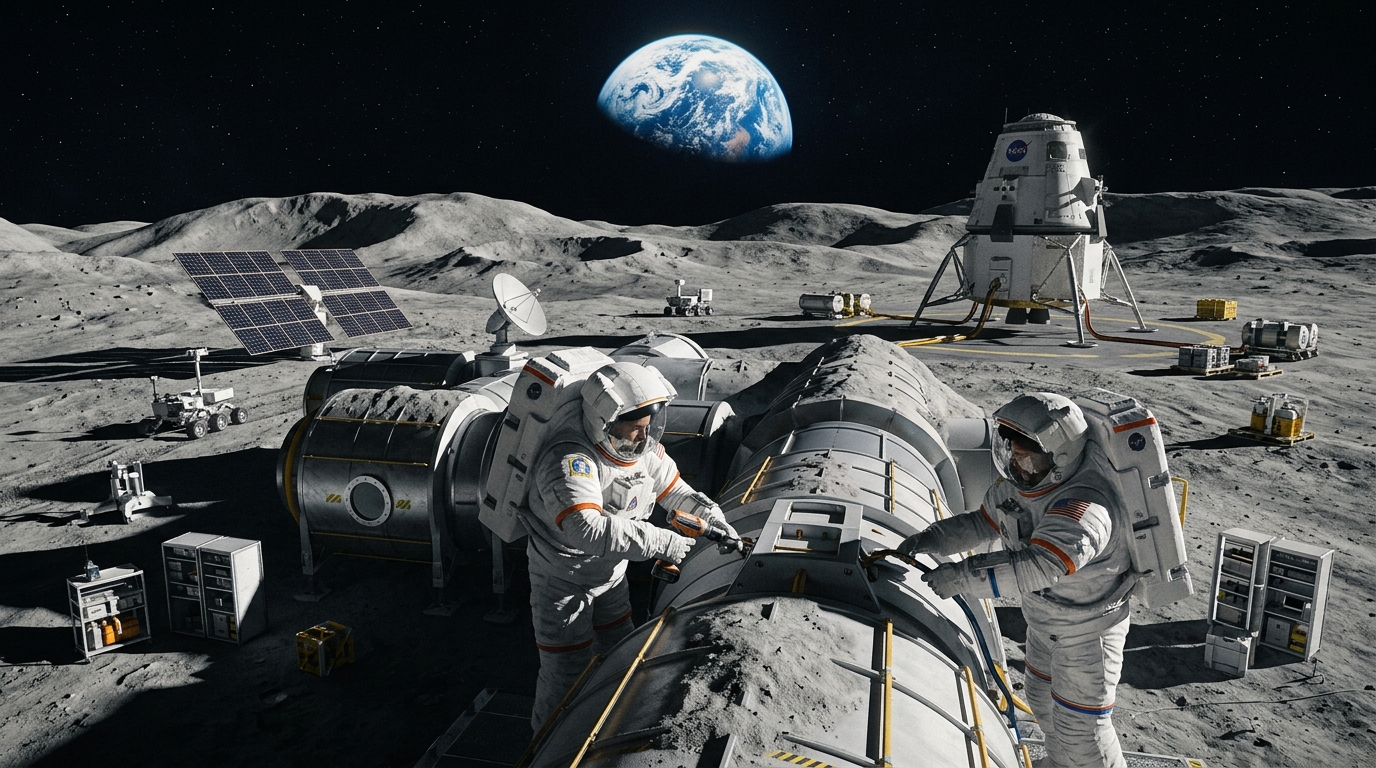
NASA Just Took Its Next Concrete Step Toward a Permanent Moon Base
NASA has committed nearly $600 million to four new robotic lunar missions, awarding contracts to three commercial space companies as it builds toward what the agency describes as the first permanent human outpost on another celestial body. The awards, announced July 1, 2026, mark a deliberate acceleration of NASA's commercial lunar strategy — trading fewer, larger missions for a higher, steadier cadence of landings designed to compound lessons learned from each attempt.
Who Got the Money, and For What
| 🚀 Company | 💰 Award | 🌕 Missions |
|---|---|---|
| 🛰️ Astrobotic | $297.9 Million | 2 Lunar Deliveries |
| 🌙 Firefly Aerospace | $144.2 Million | 1 Lunar Delivery |
| 🚀 Intuitive Machines | $148.3 Million | 1 Lunar Delivery |
All four missions are targeted for late 2028 under NASA's Commercial Lunar Payload Services (CLPS) program. Rather than developing all-new spacecraft, each company will fly an upgraded version of a lander it has already successfully flown — a deliberate strategy NASA says will let it reach the Moon more frequently while building on proven hardware rather than restarting development from scratch each time.
What Each Mission Will Actually Carry
Every one of the four landings will carry an identical trio of NASA science instruments, designed to answer specific engineering questions that matter directly for building a habitable lunar outpost:
- SCALPSS (Stereo Camera for Lunar Plume Surface Studies): A four-camera array that builds a 3D picture of how a lander's engine exhaust disturbs lunar dust during descent — critical data as heavier spacecraft begin landing closer together near a shared outpost site.
- A laser-based instrument (details still being finalized) supporting navigation and precision landing capability.
- A radiation-mapping instrument to characterize the Moon's surface radiation environment ahead of extended human stays.
Why the “Proving Ground” Framing Matters
NASA's Moon Base acting director of cargo landers, Ryan Stephan, described the expanded mission cadence explicitly as a proving ground for future outpost operations — the idea being that each landing generates engineering lessons that directly improve the reliability of the next one, rather than each mission standing alone. Lori Glaze, associate administrator for NASA's Human Spaceflight Mission Directorate, framed the nearly $600 million commitment as demonstrating the agency's intent to accelerate its long-term lunar surface presence and build the operational skills needed to sustain it.
The Bigger Picture: 17 Missions and Counting
These four awards bring NASA's total lineup of commercial lunar surface deliveries to 17 across multiple providers — a substantial pipeline that reflects how far the CLPS program has scaled since its creation. Beyond the newly announced landers, NASA also outlined parallel plans for a lunar rover, a dedicated communications network, and power systems, all aimed at supporting sustained human operations near the lunar South Pole rather than one-off scientific visits.
Industry Impact
The awards reinforce commercial lunar landing as a genuine, if still young, industry rather than a one-company experiment. Astrobotic, Firefly Aerospace and Intuitive Machines have each already flown at least one lunar lander with mixed success rates typical of an emerging spaceflight sector, and NASA's decision to award follow-on missions to all three — rather than consolidating around a single winner — signals the agency wants to preserve competition and redundancy in its commercial lunar supply chain rather than becoming dependent on one contractor's hardware and schedule.
Expert Analysis
Space industry analysts have generally read NASA's approach — flying upgraded versions of already-proven landers rather than funding entirely new designs — as a pragmatic response to the CLPS program's uneven early track record, where several missions experienced partial or full landing failures. By prioritizing iterative hardware improvement over ambitious new designs, NASA appears to be betting that reliability gains from repetition will matter more for building toward a permanent outpost than any single mission's individual scientific ambition.
Timeline
- Prior CLPS missions: NASA's commercial lunar program has flown several missions with mixed landing outcomes, building the operational track record informing this expansion.
- July 1, 2026: NASA announces nearly $600 million in new awards to Astrobotic, Firefly Aerospace and Intuitive Machines.
- Late 2028: All four newly awarded lunar missions are targeted to launch and land.
Future Outlook
With 17 total commercial lunar deliveries now in NASA's pipeline, expect the pace of Moon landings to continue accelerating through the rest of the decade, alongside parallel investment in lunar communications, power and rover systems. The real test will be whether the "proving ground" strategy actually improves landing reliability mission over mission — a pattern that, if it holds, would meaningfully de-risk NASA's broader ambition of a sustained human presence near the lunar South Pole later this decade.
Frequently Asked Questions
How much did NASA award for the new Moon missions?
Nearly $600 million total, split across Astrobotic ($297.9 million for two missions), Firefly Aerospace ($144.2 million) and Intuitive Machines ($148.3 million).
When will these lunar missions launch?
All four missions are targeted for late 2028.
What instruments will the missions carry?
Each mission carries the same three NASA instruments, including the SCALPSS camera array that studies how lander engine exhaust disturbs lunar dust.
Are these missions using new spacecraft designs?
No — each company will fly an upgraded version of a lander it has already flown, rather than developing an entirely new design.
What program are these missions part of?
NASA's Commercial Lunar Payload Services (CLPS) program, which now includes 17 total planned commercial lunar deliveries.
What is the ultimate goal of these missions?
To build toward a permanent, sustained human outpost near the lunar South Pole, supported by rovers, communications networks and power systems.
Why is NASA using multiple companies instead of one?
To preserve competition and redundancy in its commercial lunar supply chain rather than depending on a single contractor's hardware and schedule.
Key Takeaways
- NASA awarded nearly $600 million to Astrobotic, Firefly Aerospace and Intuitive Machines for four lunar missions targeted for late 2028.
- Each mission will fly an upgraded, already-proven lander design rather than a new spacecraft.
- All four missions carry identical NASA instruments studying landing dust disturbance, navigation, and lunar radiation.
- The awards bring NASA's total commercial lunar delivery pipeline to 17 missions, part of a broader Moon Base infrastructure push.
References
- Interesting Engineering
- Space Daily
- ScienceDaily
- Scientific American
- SciTechDaily