Kroger’s First Big Move Since Albertsons Fell Apart
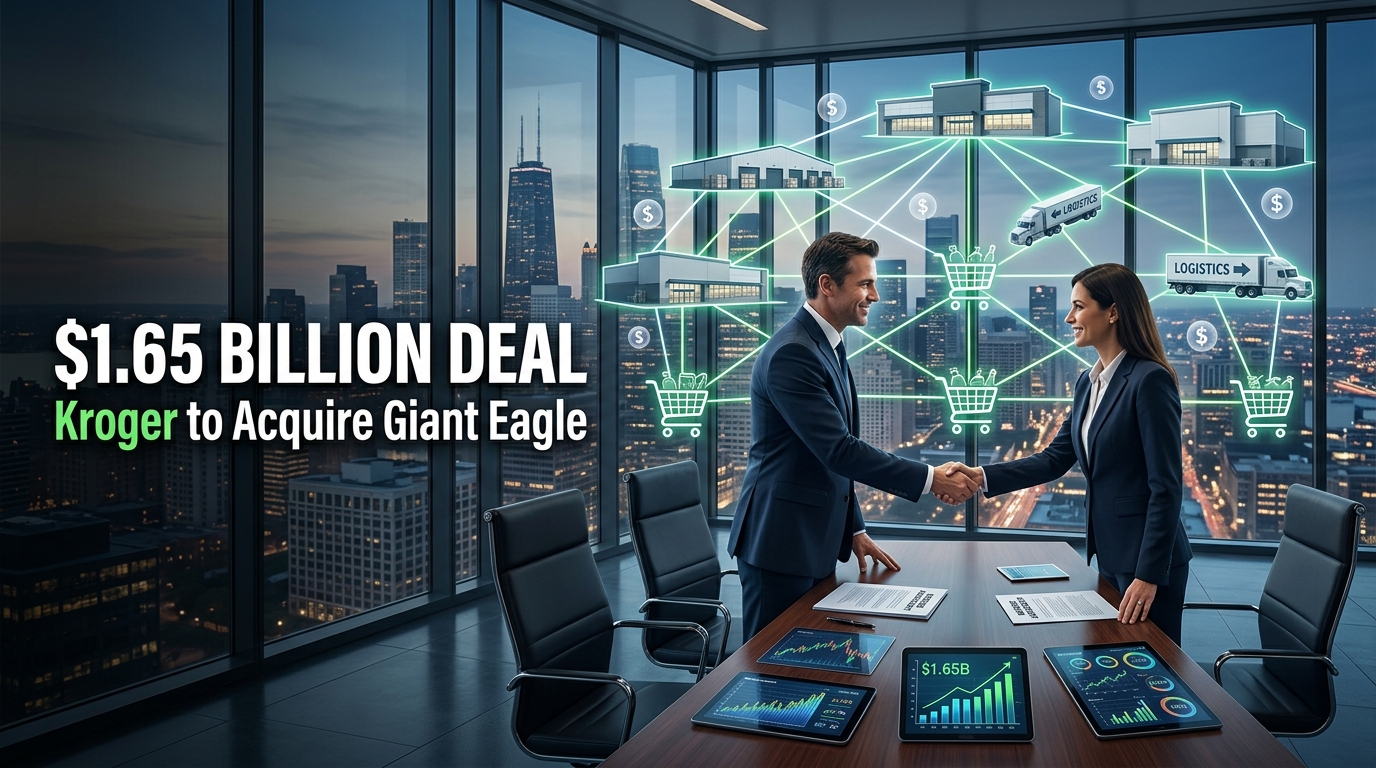
Two years after regulators killed its $24.6 billion bid to buy Albertsons, Kroger is back in the acquisition game — just at a very different scale. On July 1, 2026, Kroger announced a definitive agreement to acquire family-owned regional grocer Giant Eagle for $1.65 billion, marking Chief Executive Greg Foran's first major deal since taking the helm and the company's first significant acquisition attempt since Albertsons collapsed under regulatory pressure in 2024.
What’s Actually in the Deal
| 💼 Deal Detail | 📊 Figure |
|---|---|
| 💰 Total Deal Value | $1.65 Billion |
| 💵 Cash Component | $1.25 Billion paid in cash. |
| 📑 Assumed Liabilities | Approximately $400 Million in assumed liabilities. |
| 🛒 Giant Eagle Annual Sales | Roughly $9 Billion in annual revenue. |
| 🏪 Assets Included | 197 supermarkets and 11 standalone pharmacies. |
| 📍 Geographic Footprint | Northern Ohio, Western Pennsylvania, West Virginia, Maryland, and Indiana. |
| 📅 Expected Closing | Expected to close in 2027, subject to regulatory approval. |
Kroger's board unanimously approved the transaction. Giant Eagle, founded in 1931 and ranked among Forbes' largest private corporations, will continue operating under its own name and banner — Kroger has said it does not plan to close stores or eliminate frontline jobs, though it does anticipate "a limited number" of store divestitures as part of the standard regulatory review process.
Why Kroger Wants Giant Eagle
CEO Greg Foran framed the target as a deliberate, lower-risk complement to Kroger's existing strengths, describing Giant Eagle as a well-run, high-quality regional grocer with a strong reputation for fresh products, pharmacy, private label and customer loyalty. The strategic logic is straightforward: Giant Eagle brings an established loyalty program, pharmacy network and private-label brands into markets adjacent to Kroger's existing footprint, while Kroger contributes e-commerce, data and personalization infrastructure that a family-owned regional chain typically can't build on its own.
The Shadow of the Albertsons Deal
This transaction can't be read without its predecessor in mind. Kroger's proposed $24.6 billion merger with Albertsons — announced in 2022 — would have created a combined company with nearly 5,000 stores and roughly $210 billion in annual revenue, positioning it as a much closer rival to Walmart. It drew immediate opposition from labor unions including the United Food and Commercial Workers and the Teamsters, who argued the tie-up threatened jobs, wages and benefits, and it ultimately collapsed under regulatory pressure in 2024. Giant Eagle, by contrast, is roughly 15 times smaller by deal value — a scale far less likely to trigger the same level of antitrust scrutiny.
Industry Context
The Giant Eagle deal lands amid what dealmakers describe as an increasingly active period for consolidation across sectors, from healthcare to industrials — activity that's unfolding against a broader macro backdrop shaped by the Fed's hawkish July 2026 rate decision, which affects the cost of financing deals like this one. In grocery specifically, regional chains have faced mounting pressure from both national players investing heavily in e-commerce and data personalization, and discount competitors squeezing margins from below — a dynamic that makes a well-capitalized acquirer an increasingly attractive exit for family-owned operators like Giant Eagle rather than an existential threat.
Expert and Market Reaction
Kroger shares dipped modestly — down roughly 1% — in the hours following the announcement, a muted reaction that suggests investors view the deal as a sensible, well-sized bolt-on rather than a transformative bet. That measured response stands in sharp contrast to the market volatility that accompanied the far larger and ultimately unsuccessful Albertsons bid, reinforcing the read that Kroger has deliberately chosen a smaller, more defensible deal shape this time around.
What Happens Next
The transaction is expected to close sometime in 2027, subject to customary regulatory approvals and the anticipated limited store divestitures. Kroger and Giant Eagle have said the divestitures will be handled to satisfy antitrust regulators in specific overlapping markets, rather than reflecting any broader retreat from the deal's core footprint.
Timeline
- 2022: Kroger announces its $24.6 billion bid to acquire Albertsons.
- 2024: The Albertsons merger collapses under regulatory pressure.
- 2026: Greg Foran takes over as Kroger CEO.
- July 1, 2026: Kroger announces its definitive agreement to acquire Giant Eagle for $1.65 billion.
- 2027 (expected): The Giant Eagle transaction is expected to close, pending regulatory approval.
Future Outlook
If the Giant Eagle deal closes smoothly, expect it to serve as a template for how Kroger pursues growth going forward: smaller, regionally focused bolt-on acquisitions rather than transformative national mergers that invite heavy antitrust scrutiny. It also signals that grocery consolidation, broadly, isn't slowing down — it's just happening at a scale regulators are more likely to approve.
Frequently Asked Questions
How much is Kroger paying for Giant Eagle?
$1.65 billion total, made up of $1.25 billion in cash and the assumption of approximately $400 million in liabilities.
Will Giant Eagle stores close or rebrand as Kroger?
No — Kroger has said Giant Eagle will continue operating under its own name and banner, with no planned store closures or frontline job cuts, aside from a limited number of divestitures for regulatory purposes.
Why did Kroger’s Albertsons merger fail?
The $24.6 billion Albertsons deal collapsed in 2024 under regulatory pressure, facing opposition from unions including the UFCW and Teamsters over concerns about jobs, wages and competition.
When will the Kroger-Giant Eagle deal close?
The transaction is expected to close in 2027, pending regulatory approval and customary closing conditions.
Where does Giant Eagle operate?
197 supermarkets and 11 standalone pharmacies across northern Ohio, western Pennsylvania, West Virginia, Maryland and Indiana.
Is this Kroger’s first acquisition since the Albertsons deal fell through?
Yes — it's described as Kroger's first major acquisition since the Albertsons merger collapsed, and the first under CEO Greg Foran.
Key Takeaways
- Kroger is acquiring Giant Eagle for $1.65 billion, its first major deal since the Albertsons merger collapsed in 2024.
- Giant Eagle will keep its own name and stores, with limited divestitures expected for regulatory approval.
- The deal is roughly 15 times smaller than the failed Albertsons bid, likely making it far less exposed to antitrust risk.
- Muted stock market reaction suggests investors see this as a sensible bolt-on rather than a high-risk transformative bet.
References
- Reuters
- Kroger Investor Relations / PR Newswire
- WKYC
- Food Trade News